Today’s letter E is for exoskeleton, the outer shell on most arthropods, from insects to spiders to crabs. Mammals like you and I have endoskeletons, and internal frame for the rest of our bodies. Both types of skeletons provide a structural frame for the animal, and some animals such as turtles have both an internal (endo) and external (exo) skeleton.
In bees, the exoskeleton covers of the segments of the bee: the head, thorax, and abdomen, as well as legs and antennae. The exoskeleton is composed of a polymer of glucose and can support a lot of weight with very little material (from bee-health.extension.org), and protects bees from desiccation (losing water). Having an exoskeleton also prevents adult bees from growing, meaning they must shed their skin repeating during larval stages in order to grow.
In the below image, you can see some of the larval stages of a honey bee, corresponding to different ages. Bee larva, like that of most insects, have voracious appetites, and quickly grow until the comb is capped around day 8. In the image, many of the cells are already capped.
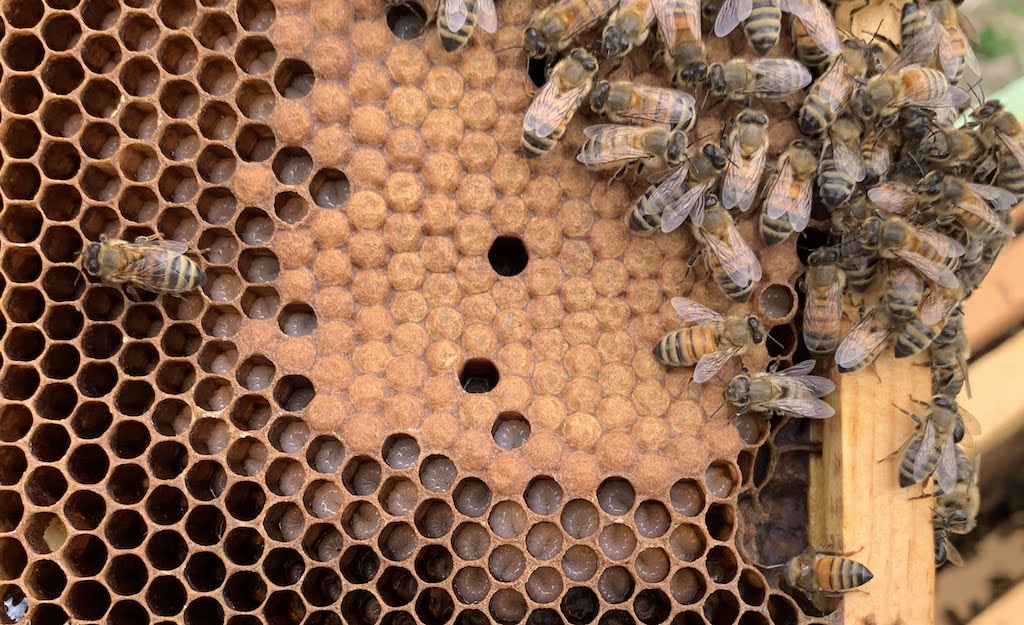
The adults in the image are roughly the same size, with similar exoskeletons. The lack of an internal frame also allows bees and other insects to have very different internals. There is no circulatory system, per se, so nutrients and detritus float around in the bee’s hemolymph.
The somewhat open space also allows bees to have expandable organs such as the crop and rectum. In the summer, the crop expands to hold large amounts of nectar; in the winter, the rectum expands until the bee can get outside to relieve herself.
Amazing creatures, these bees of ours.
May you prosper and find honey.

