Continuing our alphabet, today’s letter B is for bee brains. Most bees have a brain smaller than a grain of rice, yet they are able to perform complex tasks such as finding nectar and pollen. A honey bee can identify its nest mates and locate the exact same pebble on the edge of a stream over and over to gather a small bit of water.
Continue readingUncategorized
A is for Apiary
With the bees settling in for the winter, it is difficult to come up with a weekly topic. My first ever post here was a pun on the alphabet: A Bee Sees. So I thought it might be fun to do a weekly alphabet post, from A through Z.
Today is the letter A, for Apiary.
Continue readingKeeping bees out of the syrup
Which type of hive feeder to buy is one of those big questions in beekeeping. Every beekeeper has multiple opinions and they are probably all correct. For me, I prefer a feeder that keeps the bees out. I like to lift the top off and not see bees flying out. So feeders like this Dadant wooden feeder where the bees crawl onto floating wooden platforms don’t work as well for me.
I have some Mann Lake feeders and a couple Dadant feeders that meet my criteria. The bees crawl up to the syrup but cannot fly out. The Mann Lake one, as shown in the below image, simply has wired mesh covering a central entrance. The bees crawl the middle and down the wire to the syrup.
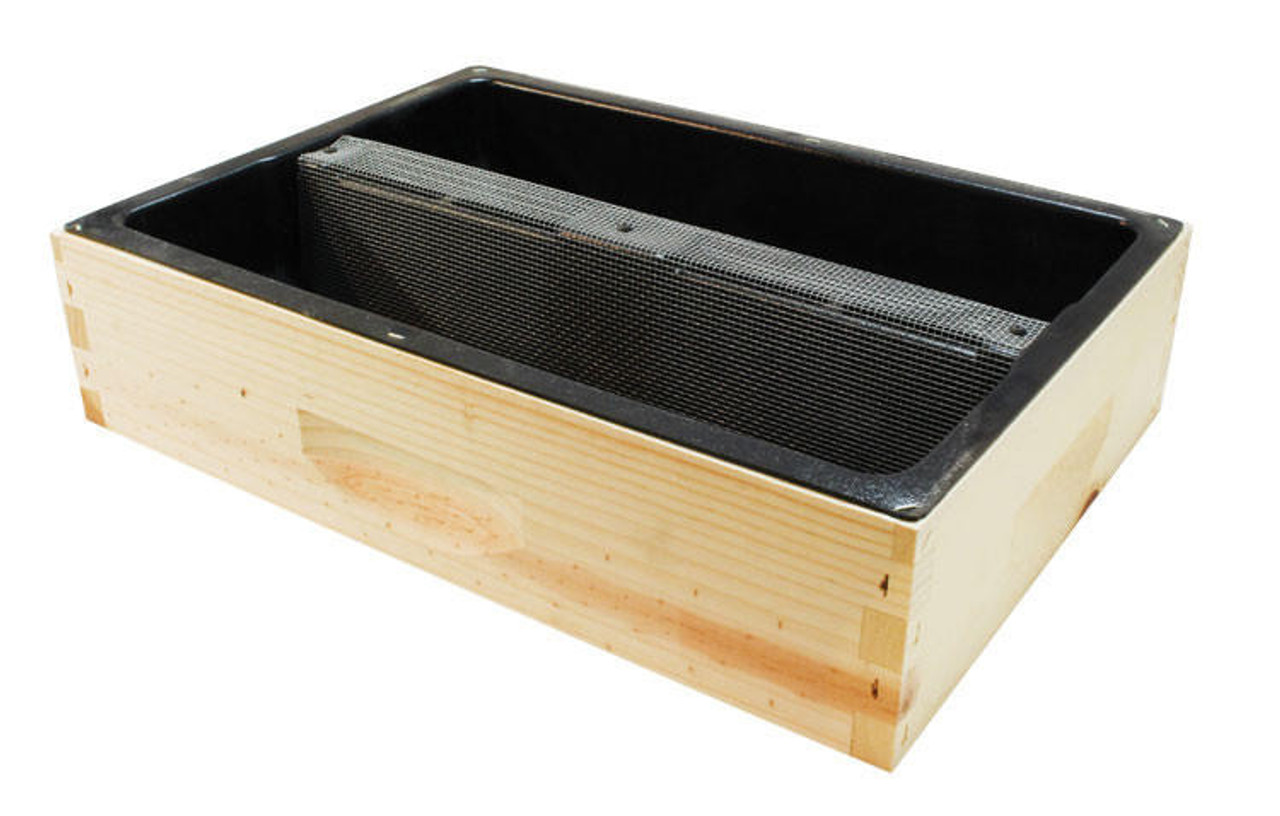
One challenge I’ve had is that once the syrup is gone, the bees can sometimes crawl out of the middle portion and into the feeder area.
Continue readingMercury is gone
My hive Mercury didn’t make it through my Formic Pro treatment. I had forgotten to remove the entrance reducers, which is recommended, but the other hives pulled through just fine. So perhaps the hive was already weak from disease or otherwise compromised, and the bees just couldn’t survive. Some pictures are below.
Continue readingYellow Garden Spider
Okay, not a bee, but I saw this HUGE spider in our yard recently so had to share it. The below picture is Argiope aurantia, or a Yellow Garden Spider. It created a beautiful web behind our pool, just sitting amongst the Lamb’s Ear waiting for lunch. I’m not really into spiders, and was a little freaked out. Wikipedia says it is harmless to non-allergic humans, so it must be true.

Since we’ve been discussing scientific classifications, spiders are in the Class Arachnida, while bees and other insects are in the Class Insecta.
May you prosper and find honey.
2023 Varroa Treatments
I did a Varroa treatment recently (on Aug 27). I like to use Formic acid, as it is an organic product produced naturally in nature and bees have a natural resistance. It doesn’t mean the chemical isn’t hard on the gals, but I’m at least using something natural. Most natural beekeeping guidelines and come country’s organic management requirements allow for natural treatments like Formic Pro and Apiguard.
Continue readingTwo-spotted scoliid wasps
Through much of August, these low flying bugs made lazy patterns above the grass in our backyard, apparently looking for something. It was bit of an adventure to figure out what they were, as they didn’t seem to stop moving. I eventually figured out they are a species called Scolia dubia, or more commonly called blue-winged scoliid wasps or two-spotted scoliid wasps
Continue reading2023 Spring Honey
This year I pulled some honey supers early as they were full and I wanted to encourage the bees to keep working away. I ended up with roughly 25 pounds of this early honey, and recently bottled it up. I was interested in seeing what the differences were between this early Spring honey and my regular season honey that I gather in July.
Continue readingBad Vespa Rising
I noticed this week an article out of Georgia about the invasive yellow-legged hornet, Vespa velutina, found near Savannah. This hornet is particularly damaging to honey bee colonies, and is a cousin of the northern giant hornet, known as the Asian giant hornet or “murder hornet” in some media. I thought a brief round up of hornets and wasps might be interesting.
Continue readingEAS 2023
Last week was EAS 2023, or the Eastern Apicultural Society‘s 2003 Short Course & Conference. The annual conference is in a different state every year. This year in Massachusetts and next year is in Maryland. The first two days is the short course, with talks and workshops on microscopy, queen rearing, honey show judging, and other topics; the final three days is the conference, with keynote speakers and the latest in beekeeping and research from some of the best in the nation.
The theme this year was Past, Present, and Beeyond.
Continue reading Bees with eeb