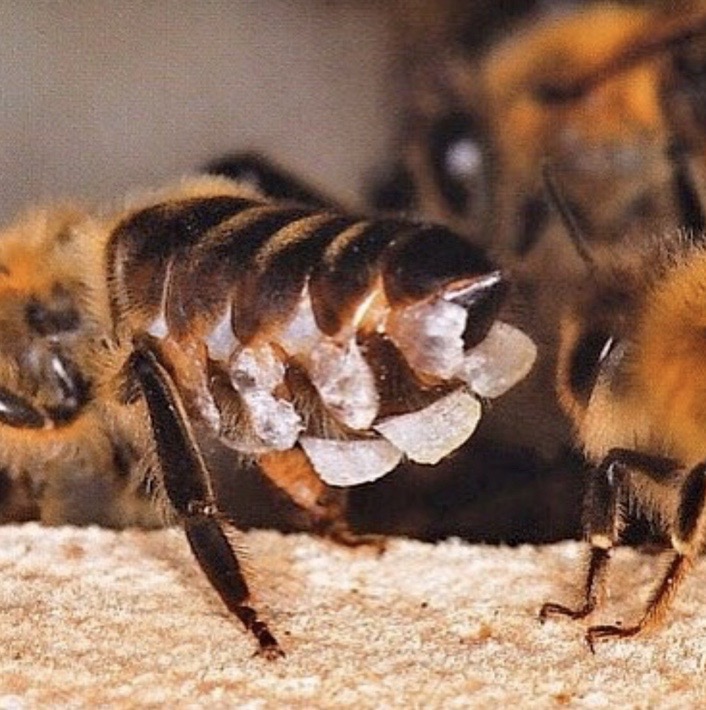
Today’s letter W is for Wax Glands. We’ve talked about wings in the past, so the wax-producing glands of worker bees seems like a good W word. Yes, I am back, at least for now. After moving both ourselves and the bees it seems like time to put up a new post.
Hello folks! Long time no post. After 28 years in the same home we have moved to a townhouse about 30 minutes away. The house is similar in size, but our yard went from 2.5 acres to a little postage stamp of a yard around the new home. We raised kids, started bees, and otherwise built our lives at that place, so it was a sad goodbye. I am close to my work commute now, and we can travel without worrying about a yard or a pool, so it seemed a good trade at this time in our lives.
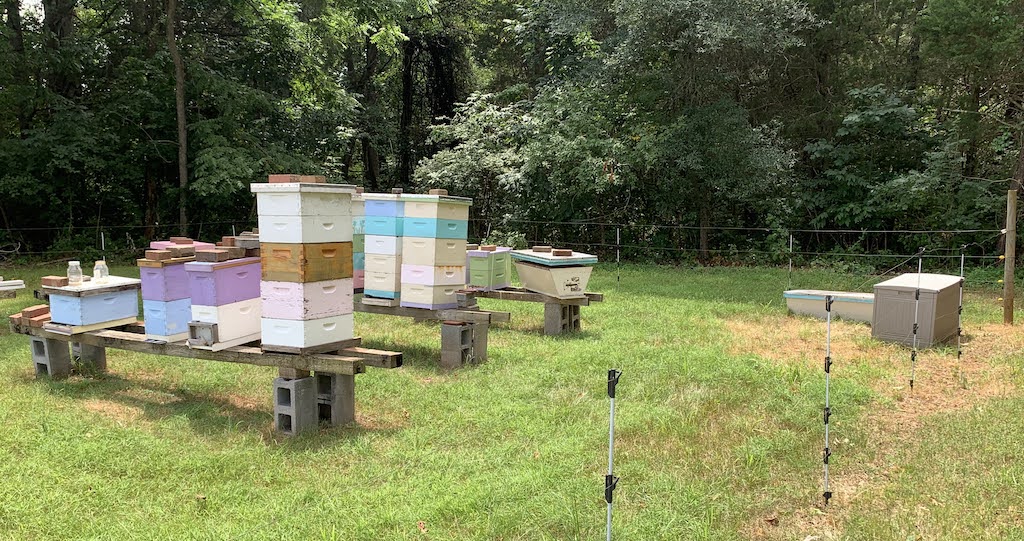
Needless to say, I had to move the bees. My fellow beekeeper Karla was kind enough to share her apiary at a local brewery. So this past June we moved the bees late at night. Was a bit of a struggle, and my son-in-law saved the day with his truck. We moved ourselves in July and have been in the new place ever since.
A couple pictures of their new home.
The hives in the front are Karla’s, in the back our mine. Since these pictures a few of these hives has to be combined with their neighbors. So I now have 6 hives that will hopefully overwinter: two full-size Langstroths, two nucs, and two top bar hives.
It is a bit of a drive to visit, and with vacation time it has been a few weeks. It will be at least another before I check on their stores for winter. Hopefully they are still doing well.
In other news, my darling daughter has taken up blogging in recent years. She is a bit more organized and consistent than I am, building around her passion for coffee and motherhood. She has a nice mention of my bees in a recent post Honey in Coffee. Her site can be found at https://ktlikescoffee.com/.
Today’s letter V is for Venation. Venation is an arrangement or system of veins, such as in leaves or insect wings. This is heavily used for species identification, as the wing patterns of different species are rather distinctive. The University of Florida has a great article
Today’s letter V is for Venation. Venation is an arrangement or system of veins, such as in leaves or insect wings. This is heavily used for species identification, as the wing patterns of different species are rather distinctive. The University of Florida has a great article on the Halictidae family of bees that includes close-up images of wing venation.
Today’s letter U is for Urohalictus, a subgenus of the sweat bee genus Lasioglossum. I had to dig deep for this one, as U words for bees are few and far between. According to Wikipedia, Lasioglossum is the largest of the bee genera, with over 1800 species. They are part of the family Halictidae, which is perhaps where the name Urohalictus derives from.
A break from our alphabet games to mention that it is swarm season in Virginia. I put a swarm trap up on a grape trellis. This past Saturday a swarm came to visit. I took this photo as they were moving into the hive. There are lot of bees, but without a home yet they are not at all aggressive.
Today’s letter T is for Tarsus, the final segment of an insect’s leg. In the honey bee, the tarsus has five segments, or tarsomeres. The legs of the honey bee are rather amazing, from storing pollen to cleaning antennae to walking vertically or even upside down.
Today’s letter S is for Stinger. We have talked about stingers before, especially in our 12 Days of Honey Bees. There we discussed how stingers evolved from the egg-laying ovipositor and thus only appear in females, but we didn’t get into the structure a stinger very much. Of course, stinger is also a great S word, so how could I resist.
Today’s letter R is for rectum. Yes, indeed, bees have a rectum and they certainly poop. In the honey bee, the rectum is unusual in that it can expand and contract as needed. In winter, when the workers may be trapped in the hive for long periods, the rectum accumulates waste matter and water while the bee stays warm in the hive. When a warm day (above 45 F or 7 C) arrives, she will take a quick trip outside the hive to relieve herself.
Today’s letter P is for Pollination. Not a bee part, I know, but it’s March 1 in Virginia and the flowers are getting ready to burst. We have crocus, daffodils, and creeping speedwell blooming so far, and more on the way. It looks like we may have some warm weather on Sunday, in which case I may check to see if the bees are bringing in nectar from the neighborhood.
Today’s letter N is for Nosonov. The Nosonov pheromone, as you might guess, is produced by the Nosonov gland. This important honey bee pheromone is emitted by worker bees to orient other workers to the colony. It used during swarming to direct workers to the new home, and whenever workers find themselves confused or disoriented as to the location of the hive. If you see a bee at the entrance with her butt up in the air, they are likely emitting this pheromone.


 Bees with eeb