Day 6: Legs

Welcome to the Twelve Days of Honey Bees, Day 6. A honey bee has six legs.

All insects, in fact, have six legs, often with one or more specializations. Most bees have a number of specializations on their legs, and this includes honey bees. An insect’s legs attach to the thorax and are normally composed of five main segments: the coxa, trochanter, femur, tibia, and tarsus. Honey bees have evolved a metatarsus in addition to the segments of the tarsus.

Continue reading

Day 5: Eyes

The Twelve Days of Honey Bees, Day 5. A honey bee has five eyes.

Yes, indeed, a honey bee has five eyes. Two compound eyes as in most insects, and three ocelli that act as photoreceptors to detect the intensity and direction of light. The ocelli (plural of ocellus, of course) help honey bees navigate during flight. They likely aid foragers when following waggle dance instructions received from other bees.

Continue reading

Day 3: Body Parts

The Twelve Days of Honey Bees: Day 3. A honey bee has a three-part body.

Like all insects and all bees, honey bees have three body parts called the head, the thorax, and the abdomen. The head is where the bee’s eyes, mandibles, tongue (proboscis), and antenna are found, while the thorax is where the legs and wings attach. The abdomen holds the bulk of the bee’s internal organs and, of course, the stinger.

Continue reading

Day 2: Antennae

Welcome to the Twelve Days of Honey Bees: Day 2. A honey bee has two antennae.

The antennae is the primary sensory organ for a bee, providing touch, smell, hearing, and taste all in two slender stalks. Each antenna is attached to the head in a bowl-like socket, followed by three main parts called the scape, the pedicel, and the flagellum.

Continue reading

A good beginning is Halictidae the battle

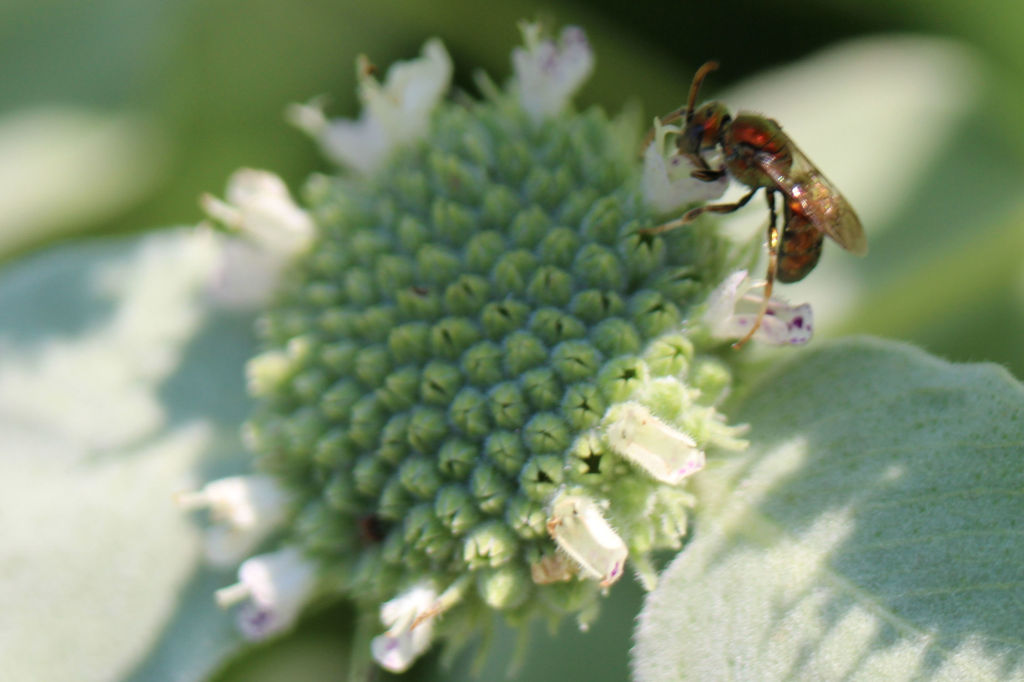
This Halictidae bee on a mountain mint flower is a Augochlorella aurata. Taken on July 21, 2019. ©Erik Brown

One of my bee goals for the year was to understand native bee species a bit better. I’m not sure how well I’ve done overall, though I have taken a bunch of pictures. In a small attempt to rectify this, allow me to discuss one scientific family of bees, the family Halictidae. Continue reading

You can’t get honey from a mason bee

We had our biggest snowfall of the winter today. Actually, it was the only significant snowfall this winter. We’ve had stretches of very cold weather, without any snow. Two days ago it was sunny and warm (60 F /15 C) out and the bees were very happy. Today is the first day of spring, and they are clustered in the hive.

As such, a good time for another post on a native bee species: mason bees. These hard working bees are smaller than honey bees and prolific pollinators. My friend Tammy gave me a book on these bees for Christmas, and it inspired me to put a Mason Bee House on my birthday list.

My top bar hives in the cold this morning (March 21, 2018). ©Erik Brown

Continue reading

Endless bees most beautiful and most wonderful

Native bees have piqued my interest this year. There are so many varieties sharing the flowers with our honey bees. We had Sam Droege of the U.S. Geological Survey speak at a recent club meeting, and he advocated the benefits of bee watching as an alternative to butterfly or bird watching. There are more bee species than butterflies and birds combined, and bees are much more stationary than most birds. Perhaps this will become a pastime.

So I have been studying the biological taxonomic hierarchy of bees lately. It is all rather confusing, so this write-up will perhaps clarify this for myself as well as a couple readers.

I gathered much of the material here from Wikipedia, and also verified some information with other sources. You may complain that Wikipedia is not the best original source if you wish.
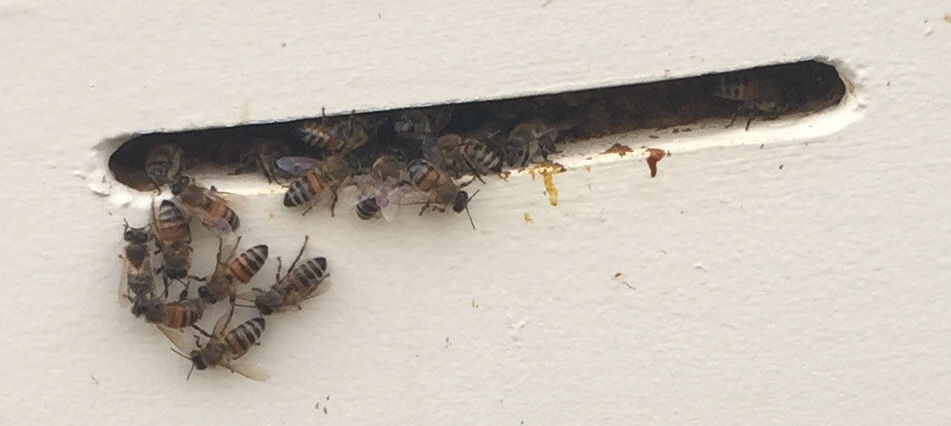
My honey bees (a hybrid of Apis mellifera carnica) at the entrance to my hive Saturn on October 28, 2017.

Continue reading

Red skies are night, to a bee’s sight

Rose Campion

Rose campion from the site Cherry Gal

On a recent visit to George Washington’s house, we happened upon their annual plant sale. Not being one to pass up a pretty plant, especially one from President Washington’s very own garden, I picked up a couple Lychnis coronaria, commonly known as rose campion.

The plant intrigued me because the fuzzy leaves reminded me of the woolly leaves of lamb’s ear, a perennial we have around the yard. In early summer, the bumble bees are all over the lamb’s ear flowers, so I thought I would add the new plant to our little bee yard. Continue reading