Z is for Zebra Bees

Today’s letter Z is for Zebra Bees. What are zebra bees, you ask? Well, there is no such thing. However, there are no insect (or human!) body parts that start with the last letter of our alphabet. Much like the letter Y, there are also no bee genus or families that start with Z. So once again I have to find a word and relate it to bees.
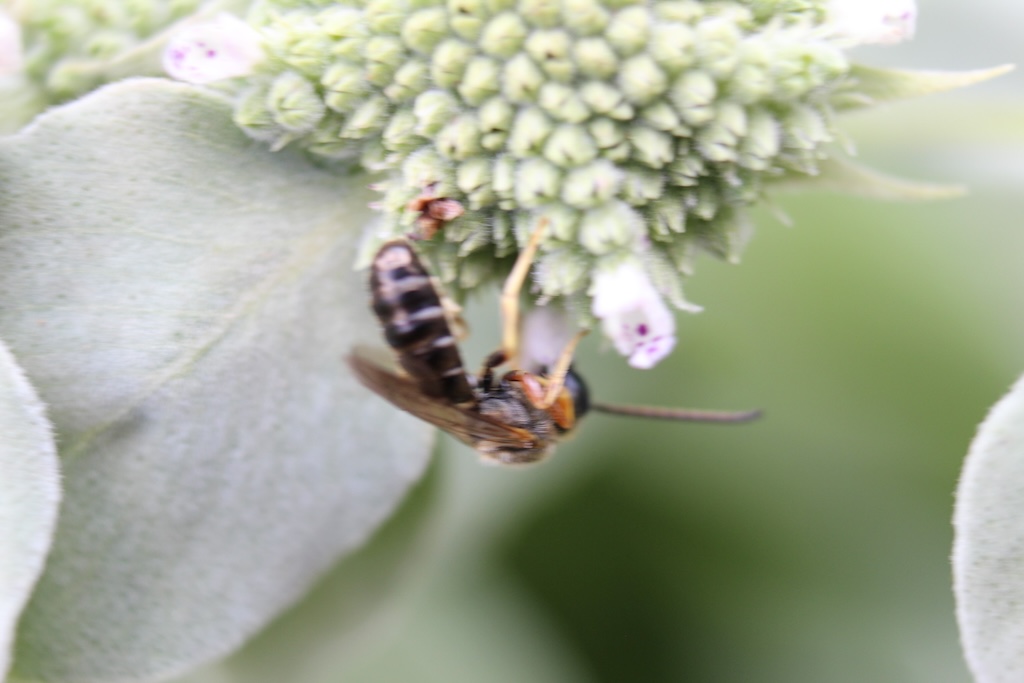
Is this a zebra bee? No, it is a Halictus confusus bee on a Pycnanthemum (mountain mint) plant.
Continue reading

Y is for Yellow

Today’s letter Y is for Yellow. It turns out there aren’t many (any?) body parts that start with Y, especially for bees. If you know of one, whether in bees or humans, please let me know. Honey bees, while often shown with yellow in drawings, tend more to brown and black, or perhaps with yellow-orange bands. There are plenty of yellow bumblebees, though, and there is even a genus Hylaeus referred to as yellow-faced bees.

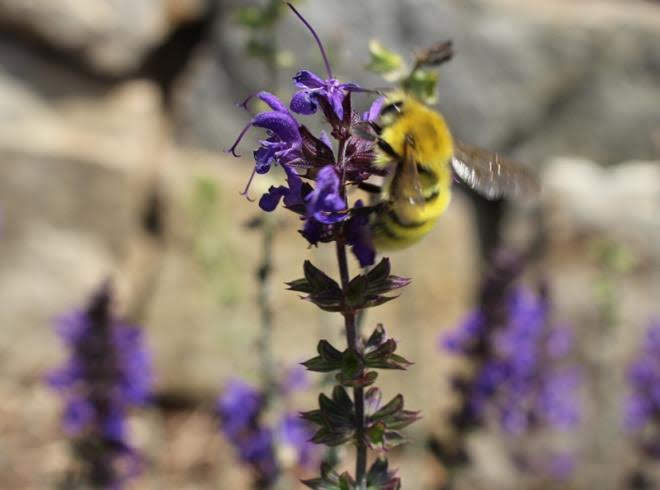
A yellow bumblebee in June 2015 on a Purple Sage I’m not sure of the species, though perhaps a male Bombus impatiens, the common eastern bumblebee.
Continue reading

X is for Xylocopa

Today’s letter X is for Xylocopa, the genus for the common Carpenter Bee. There are over 500 species of bees in this genus, with the common trait that nearly all of them nest in plant material, typically dead wood. Carpenter bees can seem a little scary, as they tend to be large bees with smooth black abdomens, and have a tendency to hover in front of people or other animals that encroach on their space. They rarely sting, however, and are more likely to fly away unless their home is directly attacked.

Continue reading

I is for iberiensis

This week’s letter I is for iberiensis. The subspecies Apis mellifera iberiensis, also referred to as the Spanish honey bee, is native to the Iberian peninsula forming parts of Spain, Portugal, and Gibraltar. A subspecies forms when a specific species adapts to an area and takes on distinctive traits that distinguish it from other subspecies. While different species are unable to reproduce, such as a dog and a cat, two subspecies of the same species can still reproduce. A subspecies is still a formal taxonomic designation, not to be confused a less formal designation like a breed or race.

Continue reading

The 12 Days of Honey Bees

If you missed it (and how could you!), we finished up the 12 days of honey bees this week, conveniently aligned with the Twelve Days of Christmas. For future posterity, here is the complete list of days.

May you prosper and find honey.

Day 12: Mouthparts

The Twelve Days of Honey Bees, Day 12. A honey bee worker has 12 (or so) mouth parts.

Bees in general have rather complex mouthparts to access the inner rewards found in flowers with all sorts of configurations. Since we not mentioned the honey bee proboscis (tongue) or mandibles yet, this seems like a good place to do so. These higher numbers are a real challenge, but the parts a honey bee’s mouth is a useful way to finish our honey bee days. Another option for 12 was honey bee pheromones, although there are actually more than 12 of these.

Continue reading

Day 11: Hind leg

The Twelve Days of Honey Bees, Day 11. A honey bee worker has eleven (or so) parts on each hind leg.

Finding an eleven in honey bees is a challenge, so I ended up with the many parts of a worker’s hind leg. If you have a better suggestion for this number, please let me know in the comments. Other options include the roughly 11 days a worker spends as egg and larva, and extending our prior day to simply say the male bees have 11 flagomeres on their antennae.

Continue reading

Day 10: Flagomeres

The Twelve Days of Honey Bees, Day 10. A honey bee worker has 10 flagomeres on her flagellum.

What the heck is a flagomere, you say? Well, I am here to tell you. You may remember from Day 2 that a honey bee antenna has three parts: the scape, the pedicel, and the flagellum. The scape and pedicel allow the bee to flex each antenna in all sorts of ways. The flagellum is where the various receptors are located. The flagellum is composed of segments, called flagomeres, with 10 flagomeres on female bees (workers and queens) and 11 on male bees (drones).

Continue reading