Today’s letter X is for Xylocopa, the genus for the common Carpenter Bee. There are over 500 species of bees in this genus, with the common trait that nearly all of them nest in plant material, typically dead wood. Carpenter bees can seem a little scary, as they tend to be large bees with smooth black abdomens, and have a tendency to hover in front of people or other animals that encroach on their space. They rarely sting, however, and are more likely to fly away unless their home is directly attacked.
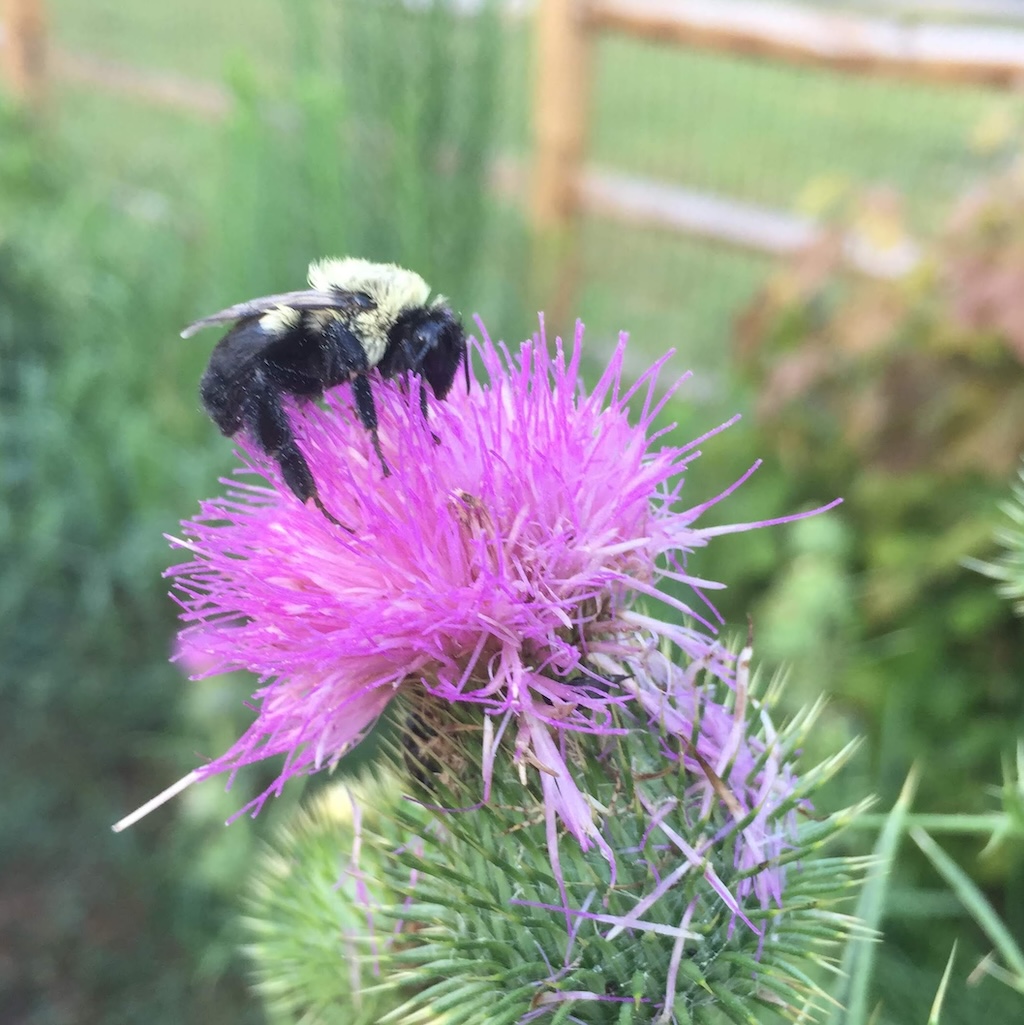
I’m no bee expert, but I think the image here is a Carpenter bee on a thistle plant. Notice how their abdomen is rather smooth. I often confuse them with bumble bees. Different regions are dominated by their own species. Where I live in Virginia the Eastern Carpenter Bee, or Xylocopa virginica, is quite common. Eastern carpenter bees nest in old wood, and will use decks or other human creations. They tend to return to the same structures year after year, so can be difficult to discourage once established.
The genus Xylocopa is part of the subfamily Xylocopinae, another X word. The subfamily includes both large (genus Xylocopa) and small (genus Ceratina) carpenter bees, as well as some specialty bees mostly occurring in South America and Africa. Most carpenter bees are solitary, though a few have limited social behaviors and will live in small groups.
May you prosper and find honey.
 Bees with eeb