Today’s letter J is for Johnston’s Organ, the primary audio sensor in honey bees. Who is this guy Johnston and why does he have an organ? Well, I will tell you.
Christopher Johnston reported his discovery in 1855 in the paper Auditory Apparatus of the Culex Mosquito. Johnston was a physician, and had a son named Christopher Johnston as well. Why the son gets a Wikipedia article and the father does not, I have no idea.
Dancing worker bees share the location of nearby food sources by emitted airborne sound signals. These are detected by other workers using the Johnston’s organ in the pedicel of the antennae. The organ consists of 240 sensory complexes the include bristles which deform along efferent directions to detect air movement, including sounds.
The pedicel is the basically the first joint in the antennae of the bee, as shown in this diagram of a flagellum of a honey bee. You can see where the Johnston’s Organ appears as part of the pedicel.

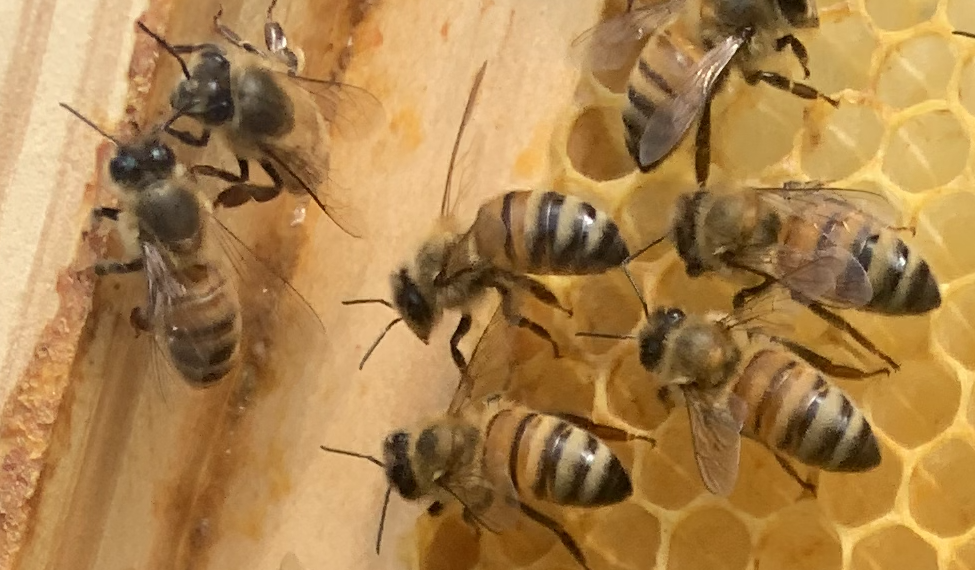
Honey bee works use their antennae throughout the hive to sense vibrations, resources, and other aspects of the dark interior. In the following image you can see the pedicel of some bees where the antenna bends near the head.
May you prosper and find honey.
 Bees with eeb