This week’s letter I is for iberiensis. The subspecies Apis mellifera iberiensis, also referred to as the Spanish honey bee, is native to the Iberian peninsula forming parts of Spain, Portugal, and Gibraltar. A subspecies forms when a specific species adapts to an area and takes on distinctive traits that distinguish it from other subspecies. While different species are unable to reproduce, such as a dog and a cat, two subspecies of the same species can still reproduce. A subspecies is still a formal taxonomic designation, not to be confused a less formal designation like a breed or race.
According to Wikipedia, there are 11 subspecies of honey bees in Europe. The Spanish bee, Apis mellifera iberiensis, is thought to be descended from African honey bees (not to be confused with Africanized honey bees in the U.S. and South America). The Spanish bee has a body similar to other European subspecies and is mostly dark brown to jet-black.
There is a study on nature.com that uses the genome of different honey bee subspecies to trace the origin and distribution of honey bees, so the identification of subspecies is more than just a fun exercise.
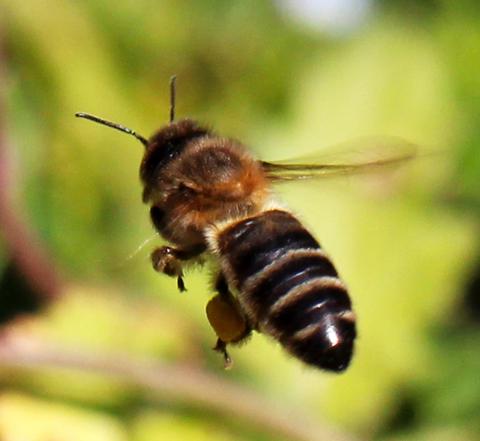
May you prosper and find honey.
 Bees with eeb