Through much of August, these low flying bugs made lazy patterns above the grass in our backyard, apparently looking for something. It was bit of an adventure to figure out what they were, as they didn’t seem to stop moving. I eventually figured out they are a species called Scolia dubia, or more commonly called blue-winged scoliid wasps or two-spotted scoliid wasps
After my recent post on the yellow-legged hornet found in Georgia, I was interested in identifying this particular wasp. On the good news front, the nest of the yellow-legged hornet was found and eradicated, so hopefully there are no more.
For these critters, I eventually caught one in an insect net and placed it in the freezer for less than a minute. The wasp was nice and still after that and I was able to take the following picture. After a few minutes in the sun, it warmed up and flew away.
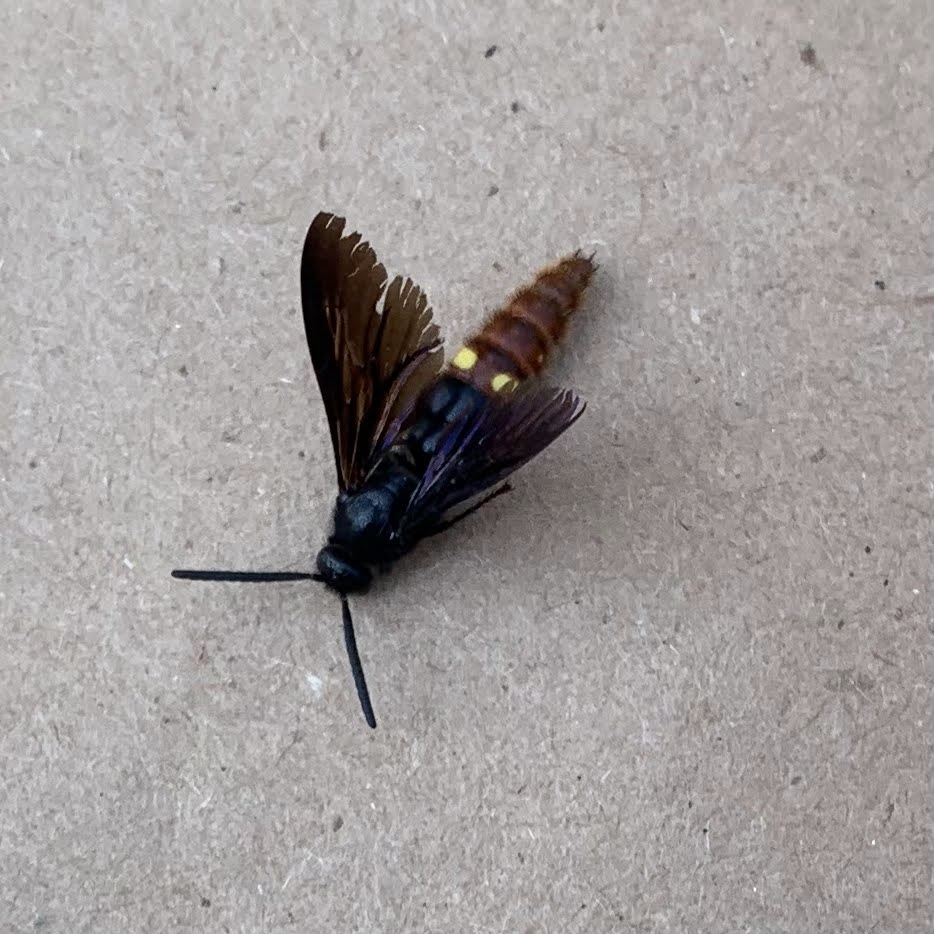
Apparently looking up an insect flying just above your lawn is a common query, as I quickly found that this is a blue winged wasp from the Genus Scolia in the Family Scolidae, as shown in the below image. I have included the yellow-legged hornet and honey bee in the image in reference to my prior post.
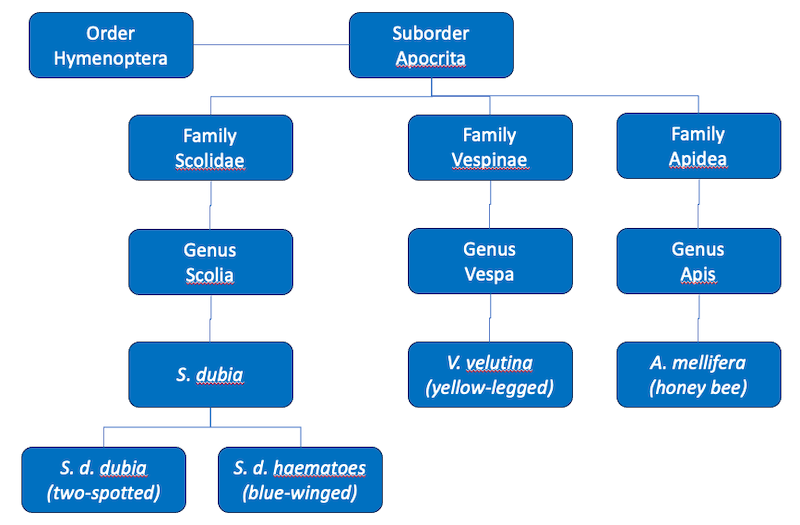
I also learned that the Order Hymenoptera we discussed last time has a couple Suborders, including the Suborder Apocrita which includes most wasps, bees, and ants. The Family Scolidae includes scoliid wasps, or digger wasps, that tend to be black in color, with the females laying eggs in larva. The females stings the larva to paralyze it, and then lays an egg inside which emerges to consume the still-alive larva. They are generally beneficial parasites which keep down populations of beetles, including Japanese beetles.
After learning this, I realized that we have indeed seen fewer Japanese beetles in our yard in recent years, so the wasps seem to have found a good food source. The species Scolia dubia has two subspecies. Based on BugGuide.net, Scolia dubia dubia has two yellow spots on its abdomen, while Scolia dubia haematodes does not. So my little friend must be the Scolia dubia dubia, or two-spotted scoliid wasp. A lot of sites seem to refer to these as “blue-winged wasps,” which is apparently not the case. So I’m glad we could clear this up, and good to know these are beneficial. I think we’ll leave them to they lazy circles around the lawn.
May you prosper and find honey.
 Bees with eeb
One thought on “Two-spotted scoliid wasps”