I noticed this week an article out of Georgia about the invasive yellow-legged hornet, Vespa velutina, found near Savannah. This hornet is particularly damaging to honey bee colonies, and is a cousin of the northern giant hornet, known as the Asian giant hornet or “murder hornet” in some media. I thought a brief round up of hornets and wasps might be interesting.
Both bees and wasps are in the order Hymenoptera, which are generally insects that lay eggs via an ovipositor, which is often modified into a stinger. This includes wasps (Family Vespinae) and bees (Family Apidea, among others). These are shown in the following diagram.
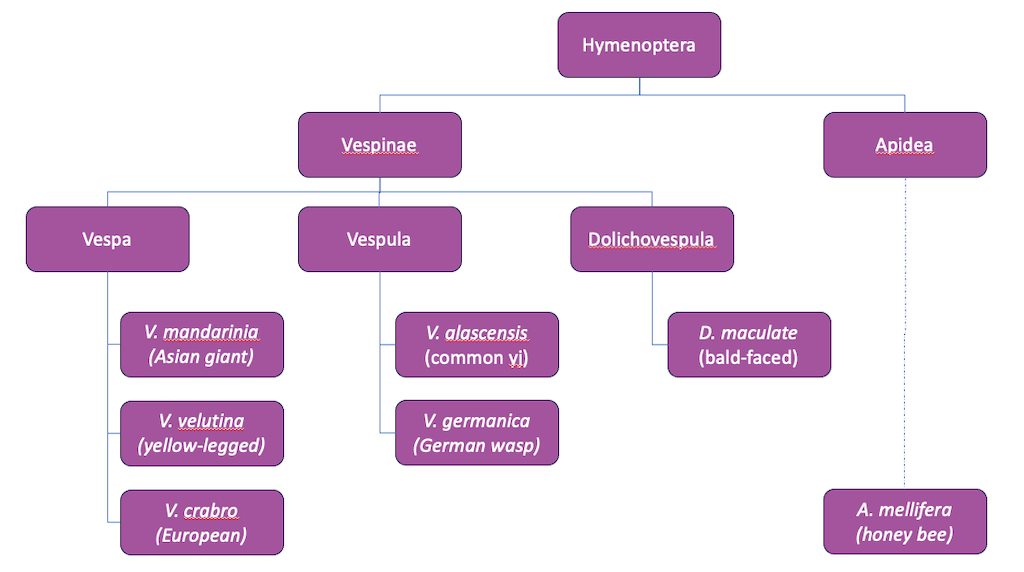
Included in the wasps are the genus Vespa, the true hornets, and the genus Vepula and Dolichovespula, both types of yellow jackets.
The wasps are in the Family Vespinae. with the specific species of each genus shown in the diagram discussed in the following list.
- Vespa are the true honets
- The Asian giant hornet, Vespa mandarinia, is the largest hornet in the world and can be devastating to honey bees. The species was seen in Washington state in 2019 but has not been seen since. Hopefully this has been eradicated for now.
- The yellow-legged hornet, Vespa velutina, is what was seen in Georgia. These are smaller than the giant hornets, though can be just as devastating to honey bees. Hopefully Georgia is able to eradicate any colonies, as Georgia isn’t that far from Virgina.
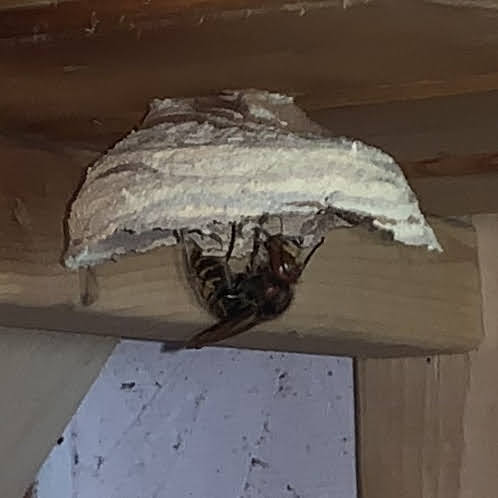
- The European hornet, Vespa crabro, is invasive but well established in North America. They are opportunistic with honey bees, and I have seen them pick up a single bee and fly away with it. The Asian hornets are more predatory and will follow a bee back to the hive in order to prey on the entire nest. The above picture shows a queen European hornet that starting building a nest in my shed in 2020. I chased her away and hope that she died in the wild.
- Vespula is a small genus of common yellow jackets mostly found in North America.
- The common yellow jacket, Vespula alascensis, tend to build nests in the ground. They can be particular nasty when mowing over the nest (trust me!) or when stumbled into by small children or pets.
- The German wasp, Vespula germanica, is a small yellow jacket that tends to build paper nests in trees. They can be very aggressive when disturbed.
- Dolichovespula wasps are often referred to as yellow jackets as well, and tend to be yellow and black in appearance.
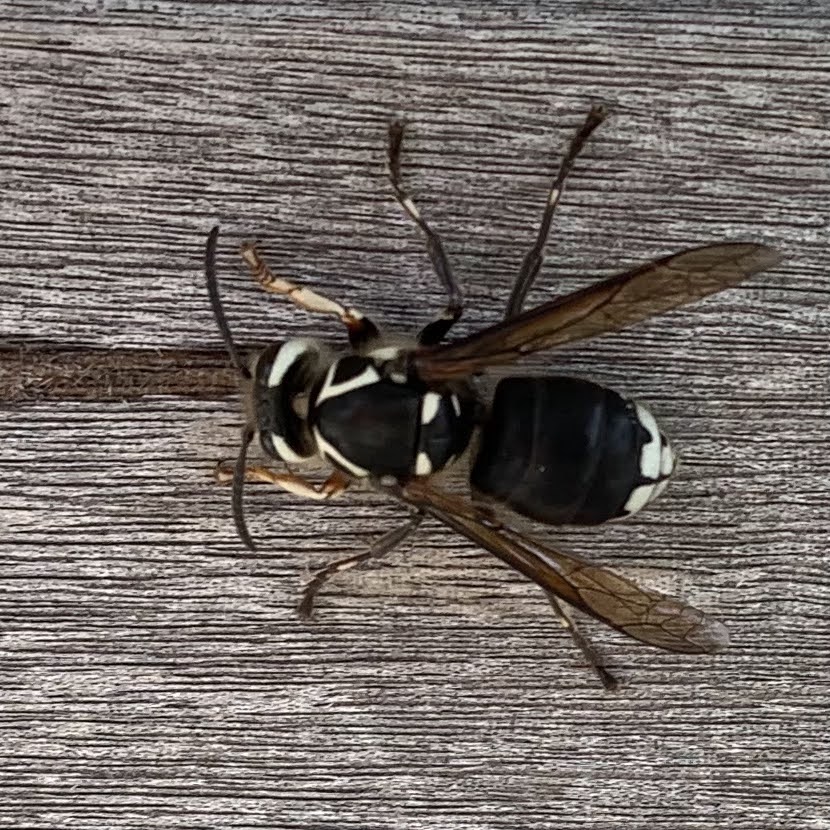
- The bald-faced hornet, Dolichovespula maculata, is not a true hornet, and builds paper nests with large populations up to 700 members. They are known to repeatedly sting when disturbed. The photo above shows a bald-faced hornet I saw a few days ago on a wooden bench in Arlington, Virginia. It appears to be gathering wood fibers, presumable to help build its nest.
Also shown in the diagram is the Family Apidea, which is also part of the Order Hymenoptera. The honey bee, Apis mellifera, is included in this family, just to contrast it with the wasps shown.
May you prosper and find honey.
The title for this post comes from the song Bad Moon Rising by Clearance Clearwater Revival.
 Bees with eeb
One thought on “Bad Vespa Rising”