One of my favorite wild bees is Anthidium manicatum, or the European wool carder bee. As indicated by its name, this is not a bee native to North America. This bee was first seen near Ithaca, NY in 1963, and is considered invasive. The “carder” name comes from their habit of pulling fibers from fuzzy plants like Lamb’s Ear to use in their nest, as carding is a term used for separating fibers.
The male wool carder bee hangs out near such plants looking for females, who in turn are seeking fibers for their nest. The male jealously guards his “turf” by chasing away other bees that visit his plants. So the male hovers around a section of plants and is a bully, head butting any bee that lands on the nearby flowers.
This is one of the first wild bees I saw in our Virginia yard. A male was hovering around the Lamb’s Ear, and it took me some time to figure out the species. He would hover in one area for a few seconds, then move to another area for a few seconds, and so forth. Whenever a bumblebee tried to visit a flower he would fly full speed into the bee to knock it off. He was hilarious, although I’m sure the bumblebees did not appreciate it.
The European wool carder bee is hard to photograph because of their constant movement, though they will visit a flower every few minutes to grab some nectar. There is a distinctive pattern on their abdomen which you can just make out in the hovering bee in the below photo (on the left). The other photo (on the right) is a Bombus Impatiens, or Eastern Common Bumblebee, visiting a Lamb’s Ear flower just outside the Carder Bee’s territory.

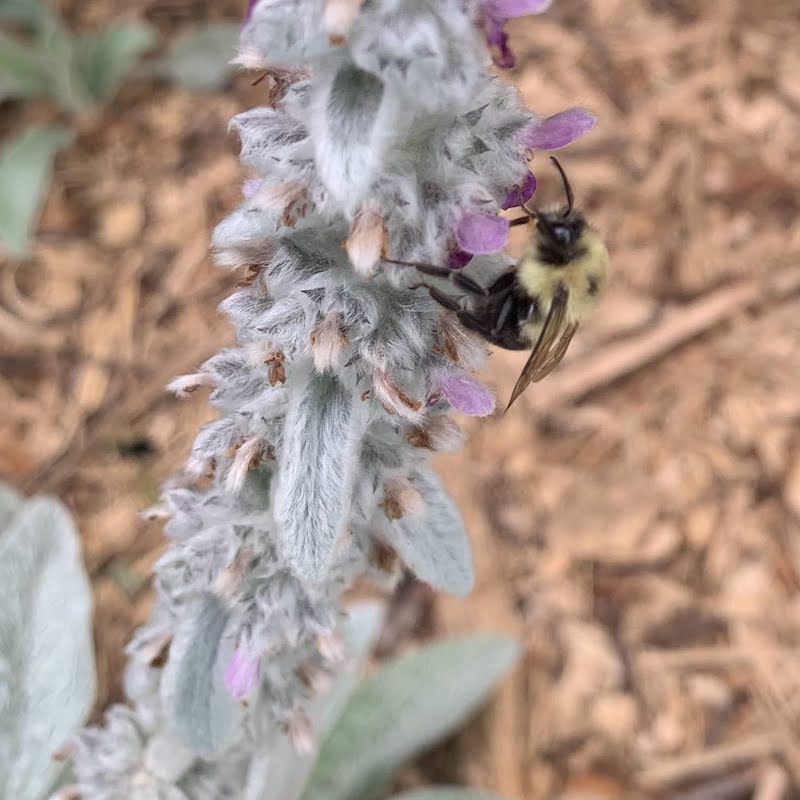
If you have Lamb’s Ear growing, take a look to see if you have a European wool carder bee hovering around to claim the territory. It is fun bee to watch.
May you prosper and find honey.
 Bees with eeb